When the Grid Goes Down: Why Your Workforce Needs an Infrastructure Strategy
There is a quiet crisis unfolding in organisations across every sector. It does not announce itself with a dramatic collapse. It shows up slowly, in attrition rates that creep upward, in knowledge that walks out the door and never comes back, in the growing distance between what leaders believe their organisations are capable of and what the work actually reflects. We have spent years optimising for efficiency. Headcount reduction. Leaner teams and calling it an agile strategy. And yet, the organisations struggling with this are not being undone by their technology choices. They are being undone by a far more fundamental failure: they stopped treating their people as infrastructure.
This concept dawned on me while I was speaking at a recent Catalyst Collective meetup, allow me to explain...
What infrastructure actually means
When a city plans its road network, it does not build roads and then wait for them to break, sinkholes to form, or potholes to take root. It schedules maintenance. It models capacity. It anticipates failure points before they become crises. It invests, consistently and deliberately, in the systems that keep everything else moving.
The same is true for power grids, water systems, digital networks and your organisational network. Every piece of critical infrastructure in the modern world is subject to one consistent principle: you protect it, maintain it, and plan for its long-term capacity, or you pay a far steeper price when it fails.
Now ask yourself: when did your organisation last apply that same rigour to its people?
For most leaders, the honest answer is uncomfortable. People are managed reactively. Or you look after the 1% that is more marketable than the 99%. Workforce planning is driven by cost targets rather than capability goals. Learning and development is a budget line item that gets cut when Q3 looks uncertain. The approach to talent is transactional at best, extractive at worst.
And the language reflects it. We talk about "human resources." We benchmark "headcount." We set targets to "do more with less." In doing so, we have accidentally adopted an infrastructure model built on neglect, and we are surprised when things fail.
The "do more with less" trap
There is a version of this argument that sounds reasonable. Automation is real. AI capabilities are genuinely transforming what small teams can accomplish. The logic of doing more with fewer people seems to track.
But here is where the infrastructure analogy becomes critical.
When a power company decides to do more with less, it cuts maintenance staff, defers grid upgrades, and reduces the investment that keeps the system resilient. We don't need to argue here, we know what this looks like in South Africa. For a while, nothing visibly breaks. The cost savings look good on a quarterly report. Then, when a heat wave hits, the coal gets wet (yes, I know) or a single failure cascades through an under-maintained system, the cost of that deferred investment becomes catastrophic.
The same dynamic plays out in organisations every day, just more quietly. When you hollow out the depth of your workforce, defer investment in skills development, and optimise relentlessly for short-term output, you create a workforce that looks functional right up until the moment it isn't.
The organisations that are thriving with AI and technology are not the ones with the fewest people. They are the ones with people who understand how to work with those capabilities, who are deeply embedded in the institutional knowledge the technology cannot replicate, and who are given the conditions to bring genuine judgement and creativity to problems. That kind of workforce does not emerge from a cost-reduction strategy. It is built, maintained, and protected.
What "maintenance" looks like
Infrastructure maintenance is not glamorous. It is consistent, often invisible, and only noticed when it does not happen. The same is true for the investment that keeps a workforce strong. It looks like development that is genuine rather than performative. Not a catalogue of compliance modules, but real investment in the capabilities your people need to grow in the direction your organisation is heading.
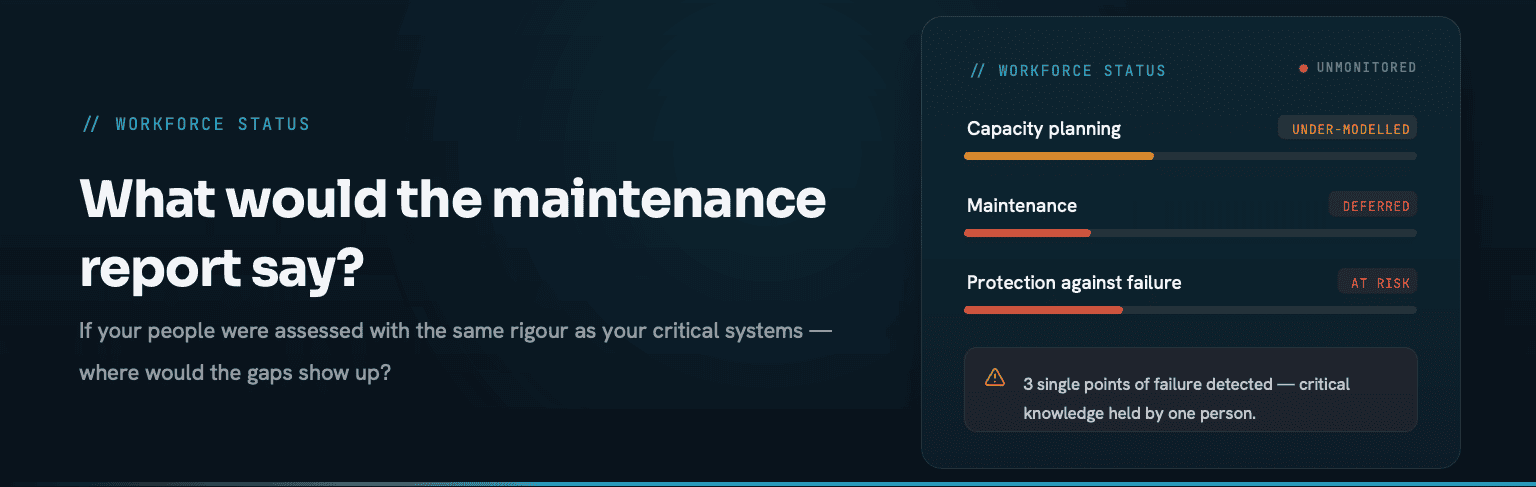
It looks like workforce planning that models capability gaps three years out, not just this financial year's headcount. It means understanding where your critical knowledge sits, who carries it, and what happens when that person leaves. It looks like leadership that understands the difference between utilisation and engagement. A team that is fully utilised is not necessarily a team that is thriving. Infrastructure under constant load without maintenance fails faster, not slower.
It looks like psychological safety as a structural condition, not a workshop outcome. People bring their best thinking when they trust the environment. When they don't, they give you compliance. And compliance, in an AI-augmented world, is the one thing you don't need more of. You need contextual accuracy and value.
The protection imperative
There is a third dimension of infrastructure management that organisations consistently underinvest in: protection.
Critical infrastructure is not just maintained. It is protected against failure modes, stress scenarios, and unexpected load. IT Infrastructure engineers understand this in great detail. For your workforce, however, that means thinking seriously about the conditions that lead to collapse: burnout, disengagement, the slow erosion of trust, the departure of institutional knowledge, and the cultural drift that makes it hard to change and difficult to attract & retain the people you actually need. Protection is not about being soft on performance. Infrastructure engineers are not soft on performance. They are rigorous about it. The difference is that they think about performance over time, under real conditions, with realistic load. They do not set a target for the server and/or compute to run at 100% capacity indefinitely and then act surprised when something gives.
Your workforce deserves the same rigour. And your organisation's performance depends on it.
So we need a different kind of strategy conversation
The leaders who will define the next decade of organisational performance are not the ones who found the cleverest way to reduce headcount. They are the ones who understood, early, that the organisations best equipped to leverage AI and emerging technologies are the ones with strong people infrastructure underneath it.
Technology amplifies capacity. It does not replace the foundation. A poorly maintained, under-invested workforce handed a set of powerful tools does not become a high-performing organisation. It becomes a faster, louder version of its existing dysfunction.
The question worth sitting with is this: if your people were assessed using the same criteria you apply to your critical IT infrastructure, what would the report say? Where are the under-maintained systems? Where are the capacity gaps? Where are the single points of failure that nobody has addressed because they haven't broken yet?
That is the conversation "People as Infrastructure" is designed to start.
People as Infrastructure is a framework for helping leaders think differently about workforce strategy; not as a cost to manage, but as a system to invest in, maintain, and protect.
If this resonated, let's start a conversation: devaan@cerebralconsulting.co.za